Writing Essentials

The Creative Process Behind Poetry: A How-To Guide

Do you wish to be the next William Wordsworth? Recite tear jerking poetry to an unrequited love and make them fall in love? Would you like to express your words as easily as taking a breath? Well, I've got you covered with my how-to guide on writing poetry.

Well, I might be tooting my own horn, but as a fellow aspiring poet, I'd love to share how I at least write poetry that makes those satisfying connections line up in my head and make lovers swoon…

DISCLAIMER: I think poetry is not something that should be methodical (I know, how ironic that this is a 'How-To Guide').

I simply want to share the creative process that I have found works for me which may benefit you in some way.

The Writers Herd Banner (6)

Luckily with poetry and any form of writing, there are limited boundaries to the themes you can write about. However, I do believe that choosing a topic which stirs you the most is the easiest to go from.

Whether that's political movements, recent break-ups, moving away from home, shitty friends or good friends, the list could go on… Choose a topic that hits you the deepest.

With this, you can take from personal and meaningful situations, unravel the event/emotion in any way you can, and go from there.

For example, I tend to write about the people in my life or about the places I've left behind.

Both, for me, stimulate intense emotions that give me a drive to write.

What challenges you? Can you think of any poignant aspects of your life that could be good writing material?

When it comes to choosing how your words will be placed, many may (including myself) don't put too much thought into it.

For me, I first have an idea of what I'd like to write about, then I contemplate how that idea makes me feel/how I envision it, and then proceed to write.

For me, going off structure limits my expression and I tend to choose a lyrical or free verse structure.

However, that doesn't mean starting with structure won't work for you. Many writers implement forms, such as a haiku, sonnet, acrostic, epic, prose and much more.

One example can be Shakespeare whose poetry utilised a sonnet form and Matsuo Bashō who uses haikus.

Maggie Queeny, who teaches poetry workshops, focuses on writing through forms. This is because it challenges experienced writers as well as helping those who are starting out writing poetry.

All in all, poetry is about testing the water and seeing what works well for your words. You may prefer to have a clear direction or to get lost in the process with a headlessness.

I try not to over explain in my poetry. For example, I don't say "I feel sad today" or "She was mean" etc…

Paint with words! Utilising poetic devices such as similes, metaphors and making the emotion/event more cryptic will leave the reader guessing and you ultimately satisfied.

For example, in my poem Riddance, I use an image of a garden to explore an old friend's abusive behaviour.

What motif (like the sun, the rain, a sentimental item) can speak for you and your subjective emotions/experiences?

Okay, now you're happy with your poem, put it down. Yep, it is always good to have a break and to come back to your poem with fresh eyes.

Although grammar isn't necessarily set in stone in poetry, you may want to look over grammar to enhance your poem and message or to just simply for the reader's experience.

Make sure spelling is correct. There is nothing worse than publishing a poem and realising you put 'their' instead of 'there' – (that definitely hasn't happened to me before…)

Final Thoughts: Enjoy the Process

I don't believe there is a right way to write poetry. To me, it's about delving into areas you tend to avoid or neglect and make them into something beautiful.

My most important piece of advice is to enjoy the process and be mindful of what poetry brings you – it can be the most wonderful tool.

By Lily
Fountain Pen

How to Craft a Story Structure

Story structures are the way in which a plot is told to the reader, and when it comes to storytelling, we've been taught from a young age that there has to be a beginning, a middle, and an end.

But there is much more to a story than that.

Writing may be a creative and artistic process, but structuring a story more closely resembles a scientific process or a cooking recipe, which, if you master, will make you a better writer.
Rising Action
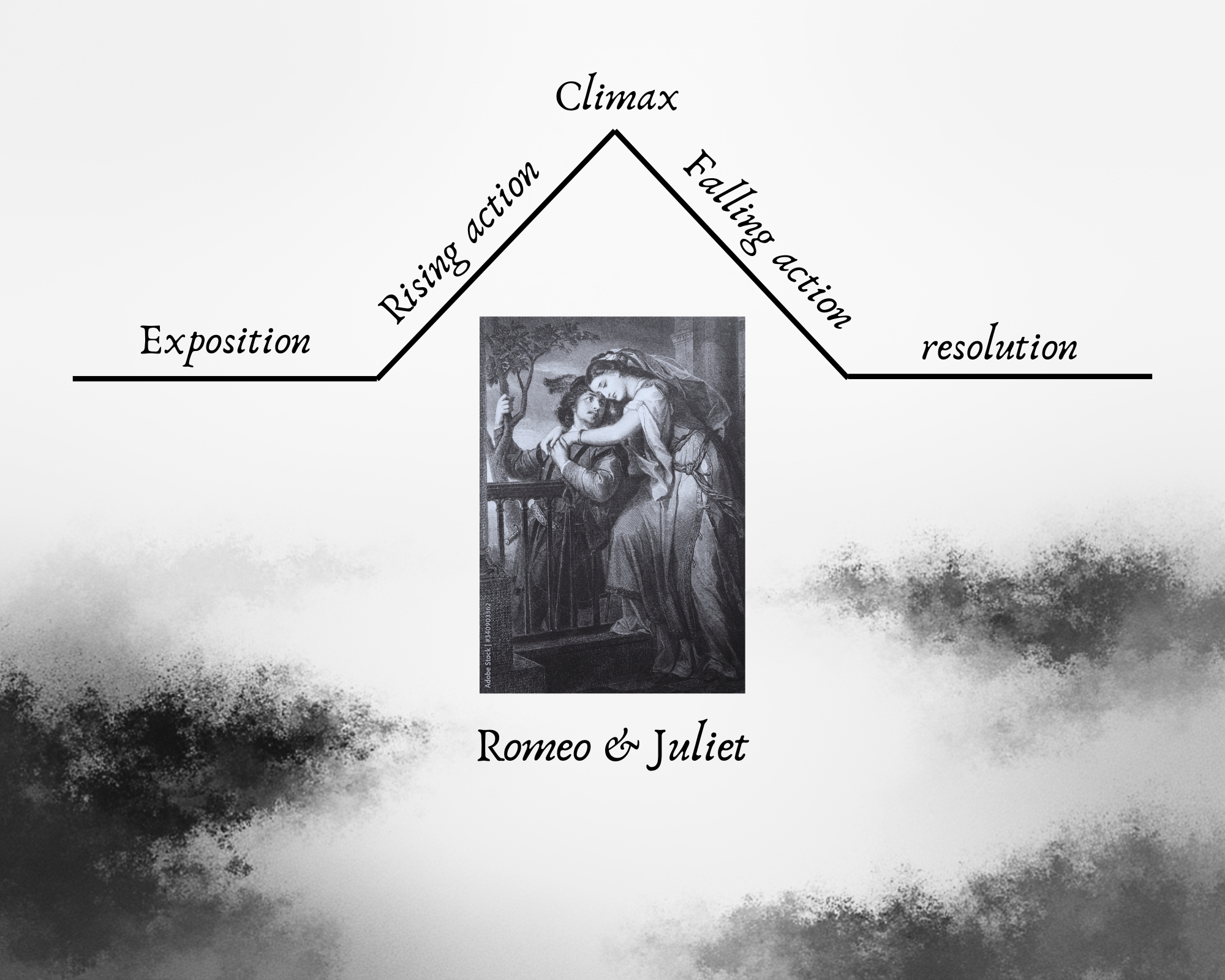
While stories can be told in various ways, most compelling narratives consist of the same core elements.

  • Exposition – Introduces and establishes the characters and important background information.
  • Rising action – A series of events where the protagonist is tested as they pursue their goal.
  • Climax – The moment of greatest tension in the story, and often the point where the protagonist seemingly achieves their goal.
  • Falling action – The protagonist must now deal with the consequences of the Climax and the results of their actions.
  • Resolution – The conclusion that ties together the plot, character arcs, and themes.

For example: Shakespeare's Romeo & Juliet

  • Exposition – There is a long-standing feud between the Montagues and Capulets.
  • Rising action – Romeo and Juliet meet and fall in love.
  • Climax – Romeo kills Juliet's cousin and is exiled.
  • Falling action – Juliet fakes her death, but Romeo isn't told the truth in time.
  • Resolution – Romeo and Juliet kill themselves, and their families' feud finally ends.

At the end of each element, a turning point or plot point is used to keep the story moving and the reader's interest solidified.

All stories consist of turning points, which keep the plot moving forward towards its ending — some resolutions even have a turning point, which is how sequels or spin-offs come about.

Turning points contain obstacles that appear in the protagonist's path, forcing them to figure out how to continue towards their goal — often changing the direction of the story.

For example: In Jane Austen's Pride and Prejudice, the most crucial turning point occurs at the end of the climax, when Elizabeth Bennet's perception of Mr. Darcy changes after reading his letter.

Most forms of narrative structure can be categorised into either linear narrative or non-linear narrative.

Linear narrative is the most common form of narration, in which a story is largely portrayed in chronological order. Flashbacks and flashforwards often confuse linear narratives, but still rely on the understanding of the linear structure of the story.

For example: Flashbacks are used in The Great Gatsby by F. Scott Fitzgerald to explain characters' connected backgrounds and relationships.

Non-linear narrative is a disjointed narrative technique where events in a story are told out of chronological order. However, the narration still needs to make sense for the story to be enjoyable.

For example: In Kurt Vonnegut's Slaughterhouse-Five, the protagonist's life experiences occur out of order due to their PTSD-induced time-travelling.

There are several types of story structures, and each has its own merits; some of which only work in particular genres of writing or specific cultures.

The most popular types of structures used are the Three-Act Structure popularised by screenwriter Syd Field, the Seven-Point Story Structure by horror writer Dan Wells, and Freytag's Pyramid (named after a nineteenth-century German novelist).

Three-Act Structure: This narrative structure is the most common technique, and the closest to the "beginning, middle and end" rule. In this, the story is split into three distinct acts: set-up, confrontation and resolution.

Seven-point Story Structure: This structure focuses specifically on the highs and lows of the narrative arc. According to Dan Wells, writers are encouraged to start at the end with their resolution and work their way to the starting point (the hook), then work towards the midpoint — with added plot points and pinch points between acts.

Freytag's Pyramid: This structure is a five-point dramatic structure based on Greek tragedies. It follows: the introduction, rise or rising action, climax, return or fall, and the catastrophe. This model is used less frequently in contemporary literature, often because modern narratives favour different pacing and emotional arcs.

Final Thoughts

Story structures are the skeleton every story needs. It's crucial for writers to understand how structuring improves writing for books, short stories, and even narrative poetry.

Though you don't need to necessarily adhere to it once created, a story structure can give you a foundation to fall back on and smaller goals to work towards.

And as with all literary techniques, once you know them, you can creatively dismantle them to your advantage.

By Rebecca
Maxim Hopman Zeeqrk7f4j8 Unsplash
