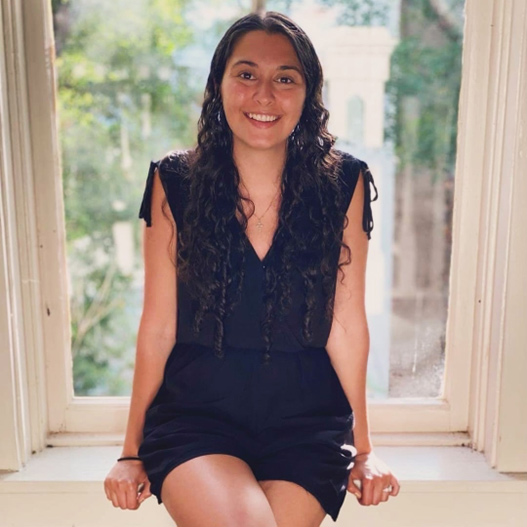
Author Interview: Ana Lee
Author of Red Summer
Interview Date: September 20, 2025
Interviewer: Nina, Contributor at The Writers Herd Location: Google Meet
"Oh man, I think I made this very complex, but also, like, I love it. I love the way that it all plays out."
In this interview, Nina sits down with debut author Ana Lee to explore the first instalment of her Stone and Scale fantasy series, Red Summer, a story about finding your place in a confusing and magical world, and the found family discovered along the way.
Ana discusses her inspirations behind the worldbuilding, her experiences of self-publishing, her best tips for overcoming writer's block, and even shares a few details about the upcoming second book, Summer of Dust and Ash, expected to be released in early 2026.
Enjoyed the Interview? Explore More Below!
Books & Availability:
Connect with Ana Lee:
Interview Highlights
"I'm already setting the scene"
Nina: So, with New Orleans as the backdrop for Red Summer, have you ever been, or is it somewhere that you've always wanted to go?
Ana: I have been to New Orleans. When my husband and I were actually moving out of Alaska, we took a pretty long road trip across the US. I think it was like maybe three or four months. We spent a few days in New Orleans, and I was just… stunned. Most of our stops along the way had been National Parks and stuff, so New Orleans was probably one of the only cities that we visited. But it was just so unique, the magical backdrop of everything, and the culture there.
Nina: So vibrant, yeah.
Ana: It's very vibrant, yeah. And it isn't to say that New Orleans doesn't have its issues, it does, but it was really just a very unique experience. It was actually while I was in New Orleans that the story came to me.
Nina: Oooh, I love that.
Ana: While we were on our road trip, I started writing the story and plotting and planning it out.
Nina: So it wasn't just that you came away from New Orleans going, "Oh, I'm full of inspiration." It was whilst you were still there you thought, "I can't not put this down."
Ana: Yes, yes.
***
Nina: So what made you want to write fantasy?
Ana: So, I grew up reading fantasy. There were probably some books I read as a kid that weren't fantasy, but for the most part, I grew up on Harry Potter, Eragon, even The Hunger Games, which is less fantasy, more dystopian. And then when I was in college, I actually read Cassandra Clare's The Mortal Instruments series and then her Infernal Devices series, and I was just blown away. I think overall, fantasy has always been my go-to. And I think it shows in my writing — that's what inspired me, and that's what I'm doing now!
***
Ana: Just in the worldbuilding, I think Cassandra Clare and Sarah J. Maas are probably my two big inspirations with how complex their worldbuilding is, and I think just the idea of multiple series that are in the same universe that play off each other was a huge inspiration for me. And it's probably going to end up being something I do with my own writing. It's like, there's this series, there'll be another series, they're connected, and I'm already setting the scene for that. So, yeah, I would definitely say that those two are probably my biggest inspirations. And then J.K. Rowling, for sure. I think the way that she, even in Book One, starts to set up things that are going to happen in Book Seven — you get to see these breadcrumbs that get tossed throughout.
Nina: Yeah.
Ana: I just love that. That's one of my favourite things about writing and reading — is getting to see those little breadcrumbs.
Nina: As a writer, you get to feel a bit smug when you lay them. You think, "Oh, people might not notice this the first time around," but by Book Three they'll think, "Oh, that's familiar."
Ana: Yeah. Before publishing this book, I had some beta readers reading it and they were like, "I don't see why this is necessary," and I'm like… it will be! *laughs*
"It's been a growing experience"
Nina: What's your publishing journey been like?
Ana: It's been a bit wild. Even when I was starting to write Red Summer, I was thinking like, do I want to go the traditional route? Do I want to do self-publishing? And I think there's a lot that plays into that, and a lot that maybe a lot of people don't really think about.
Nina: A lot of invisible labour with it.
Ana: Yeah, yeah. For me, I think my choice to do self-publishing was a lot about wanting to kind of be in charge of everything from start to finish. I wanted to be in charge of my own timelines, I didn't want to feel pressure from anyone to do things a certain way. I go into that with the knowledge that I 100% benefit from the insights and advice from other people. And that's why I ask for beta reads or talk to editors. I truly do believe in growing and learning from other people.
***
Ana: I will say there are challenges to that [self-publishing]. It doesn't get as much marketing or people don't see it as much, so I have had to research all the ways to get my book out there and create my own marketing plan. Marketing really is this other half of publishing and writing that takes a lot more time than I think a lot of people realise. And, like, learning how to do that well, and how to time things well… I'm still learning.
Nina: We'll have it by Book Two! *laughs* Book Three maybe…
Ana: *laughs* Let's try Book Five! Yeah, we'll see, we'll see!
Nina: Within the era of booktok and bookstagram, have you found that it's been harder promoting your book than you anticipated? 'Cause obviously you grow up seeing how books are published and promoted in the traditional kind of sense — like going to bookshops, seeing posters — but because these days, even in the last three years, the online presence, the promotion of books, has just gone off the charts, it's so popular, has that been a new challenge?
Ana: Resounding yes. I think especially with social media in general. You go onto Instagram and you see, like, it's the same seven books getting promoted everywhere, and most of them really are traditionally published books, which can be kind of confusing 'cause you're like, "Well, you guys have your traditional avenues — let the indie authors have booktok," but it's fine.
It's been a growing experience 'cause I think for me, when I first started promoting on Instagram, I kind of felt like, "Oh my gosh, I'm going to have to be on here every single day of my life."
Nina: Like another full-time job, yeah.
Ana: Yeah! Exactly. And then there's also the mental piece of being on social media so frequently, which can really take a toll on your mental wellness, and so I think for me I've kind of learned there's got to be balance to that. So, like, right now there's a lot of stuff going on in the world, and I'm kind of off social media right now 'cause I feel like I don't really want to be on it. So, like, the month of September, I'm just taking a break from all things book — well, besides this interview! *laughs*
Nina: Besides this! Well, thank you, I'm very honoured!
Ana: But yeah, I think there is something to just learning how to balance, and balance well. And I think especially since this is Book One of a series, Book Two plus hasn't even been published yet. So while part of me really wants to move forward and do all this promotion, I also recognise a lot of people actually don't read a series until it's complete. So I'm also learning that I can promote a little bit, but I'm not going to go all out for this book when I could be writing and finishing the series. It's just been a lot of balancing. And with booktok, it's like, I've put myself out there, and I run ads when I can, and I just have to kind of hope for the best.
"It ends up being with purpose"
Nina: So, the worldbuilding in Red Summer — it's very complex. Was it always that way, or did it gradually increase? In terms of, we've got a lot of different species, a lot of different kinds of magical elements — tell me a little bit about that.
Ana: Yeah, that is a complicated question, and it's a complicated world! From a writer standpoint, this is my first book that I've ever written, and I think I just got so, so, so excited about it, like, "I'm gonna do this, I'm gonna do this, it's gonna be great!" But I realised that there were plot lines that I didn't know were going to be plot lines until I wrote them in the first book and was like, "Oh, this will actually fit in beautifully." So, I do think it is very complex at the beginning, but it ends up being with purpose throughout the rest of the series.
All the dynamics that play out with these different types of seed — seed being people that are not human, basically. I, as a first-time writer, did not realise how complex this truly was until I was writing it and was like, "Oh man, I think I made this very complex," but also I love it! I love the way that it all plays out. So yeah, it did start that way, and I'm going to keep going till the end with it.
Nina: I love that! And I think a lot of fantasy diehard fans will also love that because so much of the appeal for fantasy is how in-depth these worlds can be, and you really feel like you escape by going to something that's so chaotically complicated — but in the most appealing way.
***
Nina: Which kind of magical type do you think you'd be? Obviously we've got the fae, we've got vampyres, werewolves, we've got… is it wytes? Am I saying that correctly?
Ana: So, with the Magem (Mahh-gem) or the may-gem — there are wytes and mages. Wytes are the females and mages are the males. But I would honestly say I'd probably be a magem, a wyte. But what I will say is that — and something I'll give away for future books, is that humans do end up playing a major part in all of this. So I would actually opt to say human.
Nina: That's a very interesting answer.
Ana: Yeah, because there will be quite a bit that happens with the humans, so I pick human!
Nina: I love that. I think you're probably one of the first fantasy writers to say that.
"I can do this even if it looks terrible right now"
Ana: Writer's block, for real, is a thing, and I think a lot of it has just been learning to discern where the writer's block is coming from. I am a perfectionist, so I am probably my biggest critic, and a lot of the time my writer's block might be coming from feeling like something needs to look a certain way before I can move on. So I think just recognising that and recognising how I can give myself grace in the moment… and I think in those moments it's reminding myself — I'll go back and read a previous chapter that I think was particularly good and I'm like, "Okay, I can write! I can do this even though it looks terrible right now."
And just reminding myself it doesn't have to look good right off the bat — that's what editing is for. And I love editing, so I think the hardest part for me is drafting, like getting the words out, so going back and editing can sometimes be very helpful. But there have also been times where I'm just like, "I can't write, edit, touch this book at all." There are times I legitimately looked at this book and was like, "I hate this book." *laughs* "I hate this story."
Nina: And you don't know where that voice is coming from and you think "urgh," and the next day you're completely fine!
Ana: Oh yeah! Yeah! And then you're like, "Actually this is a really good book and I love it and —"
Nina: "I'm glad I didn't burn it!"
Ana: Yeah, I'm glad I didn't burn it! I love it enough that I have it saved in multiple places so if something happens to one, I have a copy. Like the scene from Little Women…
Nina: I was thinking of that!
Ana: That is every writer's horror movie!
Nina: Oh gosh, yeah. Unforgivable.
***
Ana: Other things I'll do, like if I really can't push myself through it: reading other authors' writing, particularly the ones that inspired me to start with — that is huge. I think being able to take yourself out of being the writer, being the perfectionist, being the critic, and just reading a story that you're in love with — without having to feel like, "Oh, I have to edit this later." It's already been done for you, you can just fall into the story and enjoy it. I think that reignites inspiration.
"Someone just randomly shows up"
Nina: Have any characters changed drastically from your first iterations of them?
Ana: I was really thinking about this, and I don't think that they have.
Nina: That's good!
Ana: Yeah, no, I was really considering it and I think it was more like meeting them than creating them. They kind of all just came to me as people and I'm just like, okay, it's my job to write you out and be true to who your character is rather than "Oh, wouldn't this be… I wonder if this character will be this way?" They kind of just show up and I have to write out how they are. Which I've heard from quite a few authors is like, this thing, where someone just randomly shows up. Actually, I did have, in the second book, a character that randomly just showed up that I was not expecting and I was like, "Okay, this is a person now!"
Nina: You're like, "Oh, you're here! Okay, go on."
Ana: "Go on, okay! Welcome to the party."
Nina: I love that idea of them just appearing before you, you kind of feel like you have a sense of duty to tell their story for them, you're not the creator, you're just the messenger. I love that.
Ana: Yes! Exactly! Exactly! That's literally how I feel about this book. A lot of times I just feel like the plot lines are just dropped in my head and I'm like "Alright, we're going to do this." *laughs*
Nina: And do you have a favourite character, as a writer? It's a bit like being a parent and being like, do you have a favourite child? You're like, oh, I shouldn't answer this question, but…
Ana: But… and I do… I would honestly say my favourite character is Tristian, which I think a lot of people have read this book and have said the same. He is just such a complex character, and I think for him it was less that he didn't change and more that his story became apparent to me as I was writing him, and you kind of see touches or subtle nods to stuff that happened in his past that doesn't really get touched on in Book One — but will end up getting touched on in Book Two. I'm really excited for him as a character and the growth that he's going to end up going through. He's the one that people will read what he's doing in Book One and you're like, "dude, why?" *laughs*
***
Nina: Which Red Summer character do you think you're most similar to as a person, and why?
Ana: Oh gosh, this is hard. I would honestly say it's somewhere between Wilder and Terra. Wilder has this heart for people; he just wants to fight and self-sacrifice for people — that's just who he is. I think I have a tendency to be that way to a fault sometimes — which Wilder will do too. I think Terra in some ways is also that way, so I think both of them kind of have that tendency that I feel like is part of me as well. I think with Terra also… Terra channels Hermione, it's kind of who she is, she loves to read, and she loves to learn, and she loves to understand the world. I think in a lot of ways I'm also like Terra in that way — I geek out on learning.
Nina: I think that makes sense because in my opinion, if any of the Red Summer 'cast' were going to write a book it would be Terra. She'd do all the research for it, she'd be great at worldbuilding, and you know she'd come out with a banging book.
"It was all about my heart."
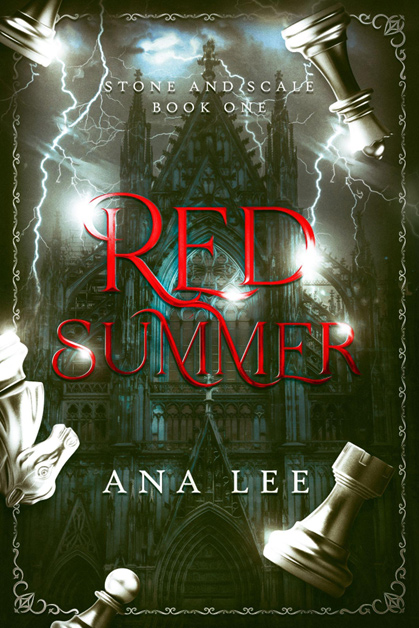
Nina: Let's talk about that cover. I think it's gorgeous. I love that you've got the little chess pieces, and you think, "How are these going to be relevant?" Can we talk a little bit about how you got that done? Did you get it commissioned or… the kind of process of getting that cover art as a self-published author?
Ana: So, I will say that was a bit daunting — like, the internet is so big and has all these options, and you just don't know where to go. And there's also this piece of, like — there's AI now, and people don't necessarily like utilising AI for their cover art, and I definitely understand the reasoning behind that. So it's like, alright, I don't want AI for my cover — but you know, I also don't want to spend a thousand dollars on my cover, so it's kind of like, how to balance that well? I actually ended up finding a really great company called MiblArt, and I checked with them. They don't use AI. I was like, great, let's go this route. They were wonderful to work with. It was a company — not like a Fiverr designer or just one person; it was a whole company.
The creator was just one person, and then I worked with kind of like a customer service person that I tossed ideas back and forth with. But what I really, really, really loved about them was there was no limit to how many edits I could make. I would give them a vision, they threw it together, I said, "This is what I like. This is what I don't like" — I think we went through probably six, seven, eight different revisions before we got to this one, and every single time they were just like, "Absolutely, whatever changes you want to make, let's make them!"
I think there were even subtle things like, "Hey, I think this red colour isn't quite the red colour that I want, can we go a bit darker?" until it was perfect. I remember saying, "Hey, the lightning isn't as bright as I'd like the lightning to be; can you add some more lightning?" So yeah, it was just really cool. I did kind of have a vision for what I wanted, and they were able to throw it together beautifully, and there's a lot of pieces with this cover. I think you and I maybe talked about it a little bit — people have made comments about how maybe the chess pieces shouldn't be there, and I went back and forth about that, and I was like, "Yeah, but I like the chess pieces, so I think I'm going to keep them in there." So really, it was just all about my heart for the cover, and I think it came out exactly how I wanted it.
Nina: Definitely, and I so agree with the chess pieces. I think it makes it stand out, because there are a lot of books that have kind of like, gothicy covers. It pulls that more to the Red Summer story by having the chess pieces around it and the lightning. It's kind of like, yeah we've got this general setting, but here's how I've made it different in the story.
Ana: And I think the chess pieces in particular, they represent this overarching idea that there's a very intricate game at play with this entire story, and you're only just beginning to see the start of it in this first book. So I am hoping that this chess theme is something that I can kind of continue on with the covers throughout the rest of the series. I haven't quite figured out how I'm going to do that yet.
