
“Before those women called me a tradwife, they had called me a religious zealot, a cult leader, a breeder. Compared to those names, tradwife seemed mild.”
Overview
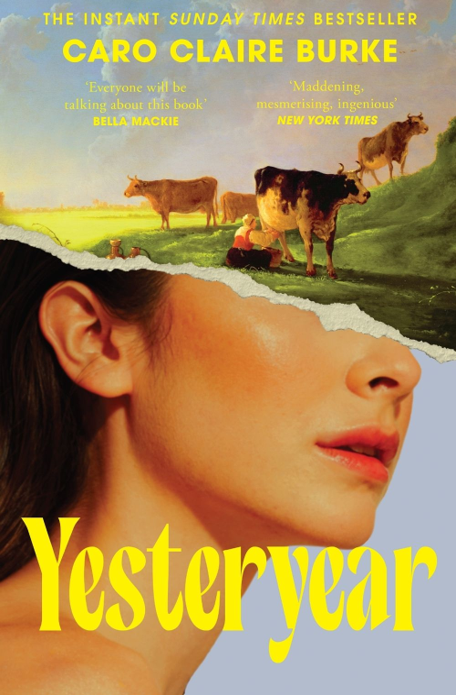
Yesteryear, as I’m sure you’ve seen all over your feeds, is a satirical take on the “tradwife” (traditional wife/housewife) influencer Natalie Heller Mills, who has built a glossy image of the perfect Christian homestead life. But when she wakes up inside the reality she has presented on social media, she must face the consequences.
If this satirical take on influencer culture and curated online lives intrigues you, find it here:
Romanticism of the Past
Burke’s protagonist serves as a mouthpiece for right-wing conservative beliefs as a way to critique them. As the reader is situated in Natalie’s mind, her opinions are expressed throughout the story, from influencer lifestyle and hate to her young adulthood. Burke explores the dangers of extreme “traditional” views and the harms they can cause. Her attitude towards her marriage, her life, and her children is viewed through this romanticising lens, in which living in this “yesteryear” era is “fun”, even though the children are abused, as are animals. Burke’s depiction of this is fantastic. Throughout the book, she presents her critiques of this mindset whilst also highlighting the beliefs.
This is shown a lot through the role of motherhood, whether that’s through Natalie herself or her mother and grandmother. Their beliefs trickle down through the generations. This is portrayed clearly in the story by her grandmother:
“The days of yesteryear were not for the faint of heart […], think how brave your great-great-great-grandparents had to be. Imagine facing down Indians with arrows. Defending your cattle from wolves. Catching fish straight from the stream. Drinking milk straight from the udder.”
This quote not only romanticises “the days of yesteryear” with the pastoral imagery of milking a cow, but it also glosses over the stark reality of this era, where racism, sexism, and domestic abuse were normalised. This romanticisation plays a part in Natalie’s controversial behaviour as a person and becomes her ruin as an influencer.
Criticism of Modernity & Influencers
Another focus of this novel is analysing falsities presented by social media influencers. To her 5 million followers, Natalie’s life seems put-together. She is a well-loved mother and farmer’s wife, with a curated feed of highlight reels: feeding chickens with her young children, making food and goods from scratch, selling ‘Yesteryear Farm’ branded merchandise with faked genuine labels. This is a large part of the family’s wealth, which is something that Natalie has always aspired to have. However, being raised in a far-right Christian family, she is taught not to seem desperate for money but instead to want to be a farmer’s wife. This is shown through the quote:
“The girls back home talked about farms only because it was distasteful for them to say what they really wanted: to be like Caleb. Wealthy.”
This clearly demonstrates Burke’s ability to capture Natalie’s mindset and present it as a collective belief, but also the damage this falsity can cause to relationships.
In creating highlight reels of her lifestyle, Natalie fails to show the reality of her life and where she is given help. Burke adopts a voice that questions Natalie in parts of the book, and where this is not explained, the voice acts as another avenue into her psychology. For example, she is asked early on:
“Why don’t you ever show all the help you have behind the scenes?” To which she replies, “We love our employees like they’re family, so we go to great means to protect their privacy as they’ve requested. I wouldn’t be able to forgive myself if my social media account ended up compromising them in any way.”
Burke’s ability to create such a distinctive character voice, where the reader is able to read between the lines of what she really means, is a testament to her blossoming skill. Of course, what Natalie really means is that it will shatter the illusion she has presented on social media: that she is a traditional, loving mother and wife, raising children, helping out around home and the farm, as well as leading a Christian life.
Voicing the Controversial and Bigoted
Natalie is shown as spiteful towards people who she perceives to have slighted her in the past. When she bumps into an old college roommate, Vanessa, she goes out of her way to show off and even makes assumptions about her job and lifestyle based on what she has in her shopping cart. Natalie’s elitism and egotistical behaviour are vividly demonstrated in the quote:
“I had the life she always wanted, the life she still wanted but could no longer admit. Vanessa was liberated, sure— but I was happy. And that was a shame, wasn’t it? The way some women so willingly compromised every ounce of themselves in the name of building a life for themselves that they didn’t enjoy.”
With this self-congratulatory tone, Burke further constructs Natalie’s character as somebody who is “anti-feminist” whilst also wanting feminists to praise her for being “traditional” and recognise that “women can do it too.” Vanessa becomes a main comparison point for Natalie, who assumes what she is doing at that stage in her life and compares herself to bolster her self-esteem.
Burke examines Natalie’s hypocritical Christian beliefs by showing she goes against the Christian beliefs she is supposed to uphold. Natalie is hateful towards individuals who do not believe in the same things as herself, calling them a string of profanities whilst also still believing she is a “true Christian.” This image is further played on by her father-in-law, Doug Mills, who is running a presidential campaign, and a lot of his policies are based on far-right beliefs. He uses his daughter-in-law Natalie’s social media posts from his events to boost his own platform, as well as using similar verbiage to highlight this connection between them. This is another element of Burke’s analysis of these individuals, both on a personal level and through Natalie as a social media influencer with a huge platform.
Conclusion
Overall, I was captured by this book and Burke’s authorial skills in creating such a well-fleshed-out character who felt realistic, as well as a mouthpiece for the author’s criticisms of social media, far-right hypocritical Christians and the platforms they have, alongside her exploration of motherhood. There are quite a few real figures that this book is obviously inspired by, and the rise of this type of content creator demonstrates the political landscape that we are in. This book does cover a lot, and I do understand the hype around it! The only thing that held this book back from a five-star rating was that I felt the ending slightly undermined the story’s progression. I felt that the “other timeline” worked better as either a metaphor for character growth or an unexplained time-slip, rather than being explained away in the ending.
Have you read this book?
We would love to hear your thoughts on this book, perhaps you agree with our review, or, disagree?
