
Content warning:
This review discusses mature themes, including child death and graphic violence.
“They called me The Morrigan. I was magnificent. I was multitudes.”
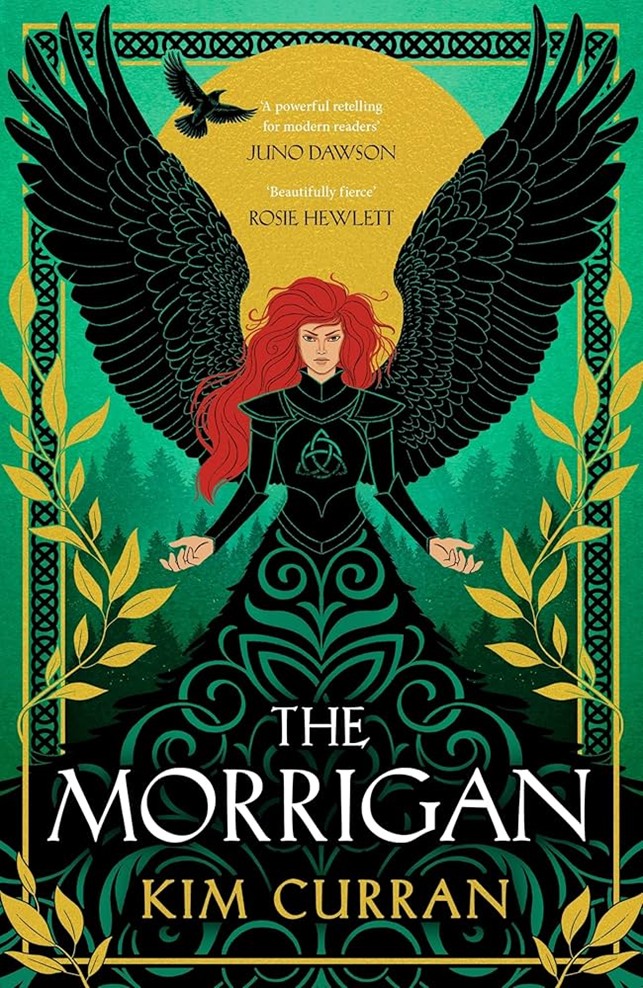
A debut novel by Kim Curran, The Morrigan (2025) is a beautifully fierce and wild novel that tells the story of Ireland’s mythological goddess of war, the Morrigan. The story follows her journey from a shapeshifting girl of the Tuatha Dé Danann to the wrathful goddess of legend.
I was completely ignorant of Irish mythology before going into this novel; the only name I recognised was Cú Chulainn, and even then, only in name. The Morrigan hooked me from the very first lines of the prologue: “They called me the Morrigan and a great many things besides. Phantom Queen. Battle Crow. Hag. But the Morrigan will do.”
Curran expands on existing knowledge of this figure and fleshes her out into someone we can recognise; perhaps we all have a little of the Morrigan in us.
The novel carries themes of rage, vengeance, feminism, love, and grief, all tightly woven through the author’s poetic writing style.
If this powerful reimagining of Irish mythology intrigues you, find it here:
Overview
This novel follows the Morrigan as she arrives on the shores of ancient Ireland with the Tuatha Dé Danann, a tribe descended from the goddess Danu in Irish mythology, to lay claim to the land. From the get-go, our protagonist is considered strange. She just doesn’t fit in with her own people. Curran writes The Morrigan in the first person, so we are directly told the legend by the goddess herself.
She is a powerful force and longs for bloody battles, for death and destruction. She is used as a weapon in the wars of her people and can’t stand peace for too long. The goddess of war and fate endures centuries as invaders come and rulers shift like an endless tide.
War and Vengeance
This book is often found in the horror section of Waterstones, which I have to agree with. I didn’t really know what I was getting myself into. There are often beautiful, tender moments depicted in prose, and then there are disturbing details of carnage and gore too. Of course, the Morrigan is the goddess of war and fury, so it’s hardly surprising to find her on a battlefield.
The violence of war can be seen in this graphic yet poetically beautiful quote:
“Blade met bone, shield met skin, and the battle began. Limbs were hacked, heads cracked, flesh opened up like flowers, petals falling to the earth.”
Vengeance also makes its way into The Morrigan. The character often takes it upon herself to seek revenge on those who have wronged her, or sometimes the women around her. A good example is when the Morrigan’s mother dies after the battle with the Fir Bolg and is left as a sacrifice for the land; the Morrigan seeks vengeance on the Druid Dian Cécht for not allowing the rites to be performed and for refusing to move the body to the ceremonial grounds. She can’t outright kill him, as her mother had placed a geas (a vow) that prevents her from killing the Tuatha Dé Danann, her own people. She doesn’t help him, and he eventually dies a painful death.
Feminism
One of the main aspects of The Morrigan is that the tale is a retelling of Irish mythology, bringing certain characters into a different light. The Morrigan in Irish myths is a goddess of battle, strife, and fertility. Her name translates as ‘Phantom Queen,’ which feels very appropriate for her.
From what I could research, Curran places more emphasis on the Morrigan’s feminine power and highlights the sexism and violent abuse that some of the heroes of old inflict on their women. The Morrigan as a character is flawed and sometimes internalises the misogyny she is disgusted by. She rages against the limitations placed upon her as a woman, yet she also often sees women as weak. This is shown in the way she prides herself on her battle lust and wits, traits often considered male attributes.
The character is fierce and defies the men around her, which is shown in the first few chapters and in this quote:
“[The poets] wrote me out entirely because I didn’t fit their narrative. I was too messy. A warrior and a mother? A seductress and crone? Poet and prophetess? No, no, no. Be neater. Be smaller. They reduced me to an old woman wailing for the dead. But I was so much more than that.”
The novel does heavily imply the stereotype that ‘men are men and will do x, y, z and women will always do x, y, z,’ without any real exploration, nuance, or queerness (which, for me, would have made it five stars).
Love, death and grief
It’s hard to imagine the goddess of war finding love or grieving loss, yet the novel allows us to see her vulnerability. When her mother dies, something in her fury changes:
“Before, the fury that had consumed me was formless. Untamed. Now, it was distilled and flint sharp. And it had a name. Grief.”
As the novel moves through the character’s arc, we see the Morrigan as a daughter, a lover, and a mother in quick succession. She embodies the pain of losing these identities, either through the passage of time or through the stillness of death. I would say there are three or four significant deaths: the first is her mother, mentioned above; the second is her lover, the Dagda, as seen here:
“I laid my hand on his face, the bristle of his beard soft against my skin. I had thought him immortal.”
These are the only people who might have loved the Morrigan as she truly was.
The third deaths are those of the Morrigan’s children; some of the most challenging parts of the novel. The first is her son, who is killed for seemingly being ‘demonic.’ This is how the Morrigan feels after finding her son:
“Pain that felt as though someone had punched through my chest and ripped my heart from it.”
And later, with her stillborn twins:
“My babies were gone. And I was empty once more, pain folding in on pain. A great rushing void that could swallow the whole world.”
It is a very heavy read and sets up the Morrigan as a powerful and resilient protagonist who has gone through it all. The story is unapologetic in these darker parts, but beautifully written as well. In these moments, you feel the feminine rage that the Morrigan feels and almost feel glad when she takes her revenge on those who have wronged her and her loved ones.
Overall
I believe The Morrigan is a stunning book, and Kim Curran writes even the goriest scenes beautifully (if that’s even possible). It has sparked my interest in learning more about Irish mythology, and I would especially like to learn more about the goddess of war and the Queen of Ravens.
Have you read this book?
We would love to hear your thoughts on this book, perhaps you agree with our review, or, disagree?
