



Content Warning:
This review contains discussion of sexual and physical violence, abuse, racism, and mature themes and language.
“You got to fight them, Celie, she say. I can’t do it for you.”
Synopsis
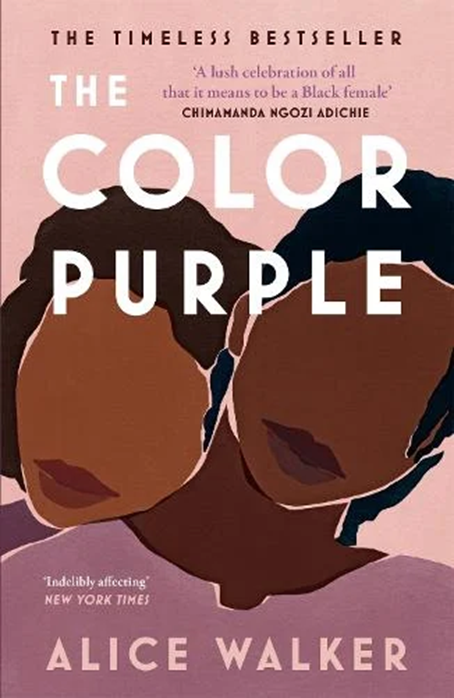
In Depression-era rural Georgia, we meet two sisters, Celie and Nettie, who are navigating life as young Black girls in the racist American South. Celie, the older of the two, is repeatedly raped by her father, resulting in two of her children being given away. She is forced into an abusive marriage with a man she calls Mr. ____, who proves to be no better than her father.
Celie meets two women whose influence fundamentally changes her view of the world and her place within it: Shug Avery, who offers an alternative understanding of religion and sexuality, and Sofia, who challenges traditional expectations of how a woman should behave. The Color Purple is an epistolary novel told largely through Celie’s letters to God after being separated from her beloved sister. These letters form a deeply intimate account of her life, written in a gritty and honest voice that confronts themes of oppression, gender, racism, and colonialism.
The latter is explored further through Nettie’s perspective, which emerges later in the novel, further expanding the narrative beyond the American South.
Race and Identity
Celie has a very matter-of-fact approach to race. She acknowledges that Black people do not have the same privileges as White people in the pre-Civil Rights South, yet she lacks the self-belief that this can be changed. She begins the novel seeing her Blackness as something of little value, and lighter-skinned or mixed-race characters are often described as “bright” and looked on more favourably.
Meeting Shug Avery marks a turning-point in the way Celie views her own skin-colour. Shug is a dark-skinned woman, described by Old Mr. ____ as “black as tar, and nappy headed,” and yet Celie is enamoured with her beauty. Walker has a Black man use what was considered a racist and derogatory descriptor to describe Shug’s hair, highlighting how deeply ingrained this derision of Blackness was during the Jim Crow era. However, Celie’s falling in love with Shug is twofold; not only does Celie discover her sexuality, but it also represents her falling in love with her Blackness and learning to appreciate her culture. In contrast to Old Mr. ____’s description, Celie says:
“[Shug] got the nottiest, shortest, kinkiest hair I ever saw, and I loves every strand of it.”
Additionally, she describes “Shug’s bright black skin,” which, given that the word “bright” had previously been reserved for lighter-skinned people, demonstrates this shift in how Celie perceives race.
The way Black people in the American South were encouraged to perpetuate this distaste for dark skin, even amongst one another, is highlighted through Nettie’s interactions with Tashi, a girl from the Olinka village where Nettie is stationed. When Adam proposes marriage to Tashi, she is reluctant to move to America because:
“it was very clear to her that black people did not truly admire blackskinned black people like herself, and especially did not admire blackskinned black women. They bleach their faces, she said. They fry their hair.”
Tashi represents this conflict beyond the American South, caught between preserving her African identity and the racial hierarchies imposed through Western colonisation and assimilation.
Language and Liberation
Language plays a key role in the novel, with Walker choosing to write Celie’s letters in African American Vernacular English (AAVE). Celie writes exactly as she speaks, using non-standard lexicon, grammar, inflections, syntax, and phonology. I listened to the audiobook narrated by Alice Walker herself, which was incredibly powerful; however, the merit of Walker choosing to write (not just narrate) in AAVE is that it forces the reader to hear Celie’s diction, as there is no alternative. It is an unapologetic style that does not cater to making the prose “more accessible.”
In contrast, Nettie, who Celie has always believed to be the more educated of the two, writes her letters in Standard English. In many ways, Celie is able to retain more of her identity and culture than her sister; her refusal to learn Standard English, even when other characters recommend she does, becomes a refusal to conform or to view AAVE as an inferior dialect.
“Plus, Darlene trying to teach me how to talk. She say US not so hot. A dead country give-away. You say US where most folks say WE, she say, and peoples think you dumb. Colored peoples think you a hick and white folks be amuse.
What I care? I ast. I’m happy.
But she say I feel more happier talking like she talk.”
Additionally, Walker draws attention to the importance of language in moving towards liberation and asserting one’s own resilience. When Mary Agnes (‘Squeak’) returns from an unsuccessful attempt to secure Sofia’s release from prison (which results in her being raped), she demands that her partner Harpo call her by her given name, rather than the demeaning nickname.
“Harpo say, I love you, Squeak. He kneel down and try to put his arms round her waist. She stand up. My name Mary Agnes, she say.”
Religion and God
“I think it pisses God off if you walk by the color purple in a field somewhere and don’t notice it.”
Celie’s perception of God was one of the most interesting aspects of the novel for me — perhaps because I have always considered myself an atheist, and yet the understanding Celie comes to of what ‘God’ actually is resonated with me more than I expected. God plays an ever-present role in the sense that Celie’s letters are initially all addressed to God; religion, however, often feels like a duty rather than a choice. Throughout the novel, Celie transitions from submitting to an inherited image of God shaped as an old, White man — to losing her faith completely. Eventually, with the help of Shug, she regains it and perceives God as a more fluid entity that exists in people, nature, and the universe at large.
“Well, us talk and talk about God, but I’m still adrift. Trying to chase that old white man out of my head… Now that my eyes opening, I feels like a fool.”
Shug introduces Celie to the idea that God is an ‘it’ rather than a patriarchal, white ‘he’ with whom they have nothing in common. Instead of rejecting God outright, Shug encourages Celie to reimagine divinity in a way she can genuinely connect with. I particularly appreciated the portrayal of God as a faceless artist, rather than a man who demands obedience. Shug’s interpretation of religion offers Celie comfort and restores agency, allowing her to exist as a believer rather than a servant.
“Any God I ever felt in church I brought in with me. And I think all the other folks did too. They come to church to share God, not find God.”
Shug’s view focuses on what this concept of God can offer people, rather than what people owe to God. Religion becomes a source of community and hope, felt through connection with people rather than through churches or holy texts.
Gender and the Female Experience
During this period in history, women were expected to adhere to strict gender roles that confined them to the domestic sphere: raising families and serving their ‘master’ (husband). This expectation is reflected in Harpo, Celie’s stepson, who struggles to reconcile his love for Sofia, a headstrong woman, with his belief about what marriage should look like. As a result, he is advised to repeatedly beat her into submission.
“Well how you spect to make her mind? Wives is like children. You have to let ’em know who got the upper hand. Nothing can do that better than a good sound beating.”
Harpo is reluctant to hurt the woman he loves, and eventually asks Celie for advice. The reader’s expectations of this conversation are completely subverted; here, Celie (a woman abused by her husband) is given the chance to spare her friend the same treatment. However, Celie’s internal struggle and insecurity lead her to tell him to “beat her.”
“I say it cause I’m a fool, I say. I say it cause I’m jealous of you. I say it cause you do what I can’t…
A girl child ain’t safe in a family of men. But I never thought I’d have to fight in my own house…
I loves Harpo, she say. God knows I do. But I’ll kill him dead before I let him beat me.”
Sofia is strong in a way Celie envies, and Celie senses that Sofia cannot help but pity her. Where Celie’s resilience takes the form of quiet refusal, Sofia’s is physically defiant — a louder challenge to misogynistic norms. She takes no nonsense, behaves as her brothers do, and when her husband hits her, she hits him back. This moment is significant for Celie’s journey: the two women bond through shared suffering, and Sofia’s anger sparks a fire inside Celie, where she once forced herself to “feel nothing at all” in response to abuse.
Like Sofia, Shug Avery is another self-assured woman who mentors Celie. Celie’s obsessive admiration of Shug is both attraction and envy. Shug supports herself financially through her successful singing career and takes lovers as she pleases.
“You know Shug will fight… Just like Sofia. She bound to live her life and be herself no matter what.”
Sofia and Shug defy these sexist rules with such vigour that they inspire Celie to redefine her understanding of what it means to be a woman. The sisterhood between them is crucial to Celie finding her agency. Without their influence, she would never have had the self-belief to start her sewing business, which gives her economic independence for the first time in her life.
“What Shug got is womanly it seems to me. Specially since she and Sofia the ones got it.”
By the end of the novel, gender roles have blurred: Celie teaches Mr. ____ how to sew, while Harpo cooks, changes his baby’s diaper, and shows affection in ways he would once have found emasculating.
Queerness and Sexuality
Celie’s sexuality is directly tied to her sense of self-worth. Sex had always been a way for men to assert authority over her, leaving her with a damaging relationship to both sex and her own body. In discovering her queerness, Celie also begins to reclaim her confidence and her capacity for physical pleasure. Her idolisation of Shug Avery is established early on, but when they finally meet, it becomes clear it is not just admiration, but desire too. Shug teaches Celie how a woman can, and should, find sex pleasurable — at a time when Celie does not even know her own anatomy. It is a significant moment when Shug renames Celie a virgin, because she has never had a consensual sexual experience, thus giving the power back to her.
Not only homosexuality, but even heterosexual intercourse is often taboo in religious spaces, so Walker’s explicit exploration of the relationship between sex and God is both bold and effective. When Celie struggles with God and sex morally coexisting, Shug is quick to dismantle the belief that pleasure is sinful or filthy:
“God don’t think it dirty? I ast. Naw, she say. God made it.”
She helps Celie see that sex is just another of God’s creations; like the colour purple, it is a beautiful thing waiting to be experienced.
“God loves all them feelings. That’s some of the best stuff God did. And when you know God loves ‘em you enjoys ‘em a lot more”
The Novel’s Legacy
When The Color Purple was published in 1982, Walker was accused of portraying Black relationships in a negative light, betraying her race, and of being a lesbian. Despite this backlash, the novel won the Pulitzer Prize for Fiction in 1983, making Walker the first Black woman to receive the award. At its core, the novel is a celebration of human connection, resilience in the face of oppression, and the search for meaning. Frequently challenged and banned in schools across the United States, The Color Purple nevertheless endures as a modern classic. Its portrayal of Black women’s resilience during the Jim Crow era continues to resonate.
Have you read this book?
We would love to hear your thoughts on this book, perhaps you agree with our review, or, disagree?
