
“If they thought her a monster, so be it. A monster she would be.”
Overview
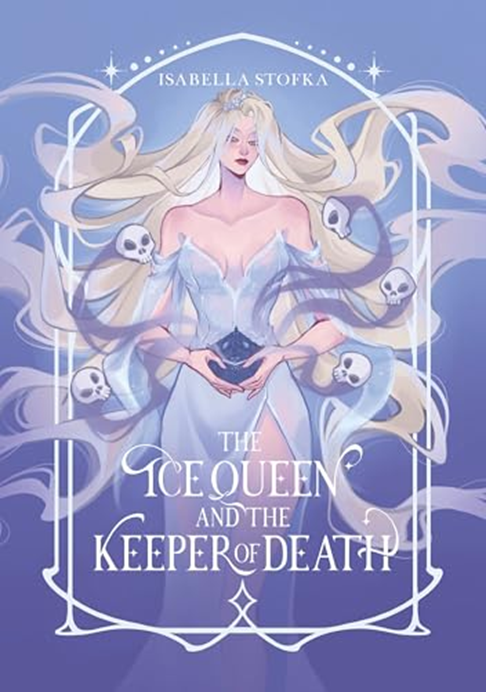
The Ice Queen and the Keeper of Death is Isabella Stofka’s second indie-published book. It is a New Adult Romantasy loosely based on the Greek myth of Pandora’s Box, following the perspectives of three characters: Wynter (Ice Queen), Niav (Assassin), and Kieran (Rebel). As they stand against tyrant Evander, perceptions of good and evil are questioned, while the fight between mortals and immortals rages on.
If you’d like to support Isabella and her newest indie novel, you can find it here:
Mythology & Worldbuilding
Once again, Isabella’s worlds are highly imaginative and full of lush descriptions, influenced by Greek mythology. She has reimagined gods and goddesses in her own way, creating new power systems, monsters, and mythos that the world is built on. As with Curses of Lavender, the mythology is loose; in her own words, she has described it more as a reimagining than a retelling. In the pages preceding the novel, she includes a character list to ensure readers are able to keep track of the names and roles of the gods.
Larger elements of the mythology will unfold in later instalments of the series, but as this is the start, seeds are already being planted. This is shown through the significance of mythological quartets in the story, highlighted in the quote:
“After the creation of the Four Evils, the humans were suffering, succumbing to pain, or killing one another out of jealousy and hatred. Death claimed them all. […] so she created the Spes, three beings of hope, born to match the power of the Four Evils.”
With the clear emphasis on Good and Evil groups, it is clear that this is an important theme and will continue throughout the series.
Good Versus Evil: Betrayal and Characters
As aforementioned, the themes of Good versus Evil are thoroughly elucidated in this book and will continue to be expanded throughout the rest of the series. This theme is also demonstrated through the implementation of morally grey characters, constantly teetering on the edge of good and bad actions. This differs from Isabella’s debut novel, Curses of Lavender, which, aside from the antagonist, was mainly full of good characters.
It also is tonally darker than Curses of Lavender, as it draws a lot from mythology (which is often dark itself), with gods who create pain and suffering. In this book, Stofka starts to deconstruct the idea of Wynter being a true “monster”, with dreams showcasing her memories, such as the tragic death of a friend who, while trying to save her, is accidentally frozen.
With the Good and Evil balance, there are also political discussions in the book, as the immortals hold ‘The Giving’, a gift-receiving ceremony where the citizens of Eehmra must give contributions to the immortals, and if they are not to their standards, the nominated individual is killed. This is spearheaded by one of the main four, Evander, a power-hungry tyrant who bullies those around him into joining anti-mortal attacks. This creates one of the main struggles and tensions between the characters. Wynter and Niav are both immortals and take part in this ceremony, hurting people in the town. Kieran, a mortal, has been taught to fear the Ice Queen, shown in the quote: “All heed this warning, this tale of the Ice Queen…”
With Wynter being a morally grey character, there are also scenes demonstrating her guilt and her motives for joining Evander’s side.
Romance, Romantasy, Enemies-to-Lovers
With the growing tension and wars between the mortals and immortals, alongside the inclusion of morally grey characters, this is the perfect cocktail for an enemies-to-lovers storyline (or a couple!) that will be expanded on as the story continues. This slow-burn romance is built upon in the first instalment, but I’m really excited to see where it goes from here.
The romance between Kieran and Wynter has more of a focus in this book, but it also insinuates a romance between Niav and Draven (Death) that will be featured as the series continues. Even with these romances, the female protagonists remain strong. As with her debut, Stofka always creates strong female protagonists, even if they are emotionless like Wynter or emotional like Thicket — they always prevail as strong and powerful women. With Stofka’s exploration of morally grey characterisation, there is also hope that the emotional side of Wynter’s character will be explored further down the line of the series.
The idea of thawing out emotions is something that is beginning to be established in this book. The idea that an Ice Queen is outwardly seen as a threat and a dangerous immortal, but is really an introverted and conflict-averse individual, is something that Stofka has begun to unravel.
Quotes like “I know you can’t feel emotion, but that doesn’t mean you have to let that define you” indicate that Wynter’s backstory has barely been uncovered yet. She may seem like a ‘monster’ now, but we still do not know what she was like before. Having woken up in a frozen river with her memories lost, she is still able to define herself. This exhibits Stofka’s worldbuilding ability as well as her character creation, and inspires curiosity and a want to know more about Wynter and the world around her, especially as the stakes begin to rise.
As tropes like enemies-to-lovers are becoming increasingly popular, this was a trendy inclusion on Stofka’s end, but it also works perfectly in the novel and, unlike other Romantasy books, feels impactful. As Stofka demonstrates, she is great at building tension between characters and is only improving her skill as she continues to write. Her inclusion of tropes feels topical but well implemented, which is a testament to the skills she is learning as time progresses.
Final Thoughts
As with Curses of Lavender, I was part of the Street Team and was also a Beta Reader, providing feedback and edits as chapters were released, which made this book feel special to me! Thank you to Isabella for providing me with this opportunity! Isabella is truly establishing herself as a great voice in New/Young Adult fantasy & Romantasy, balancing incredible themes while also fleshing out characters and their arcs.
As a first instalment in a series, it allows room for the characters to introduce themselves and lays the bones of a Greek mythology-inspired Romantasy series. I cannot wait to see where she goes with these books.
Have you read this book?
We would love to hear your thoughts on this book, perhaps you agree with our review, or, disagree?
