
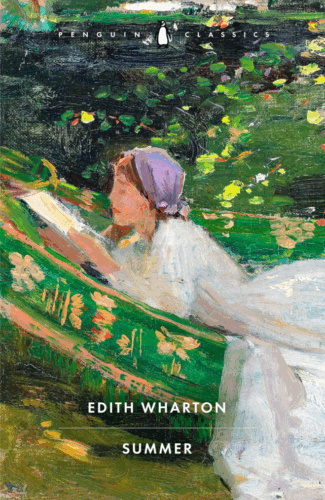
Summer was absolutely nothing like what I expected it to be. In essence, the story dripped with bright, hot sun. Each time I flipped a page, I could smell the lavender and the old wood of the houses of North Dormer, hear the creaks of the town’s old library, and feel the dust covering each book. I went into this story thinking it would be beautiful, leaving me fulfilled and happy. Instead, I put the book down in shock, realised I was betrayed, and was left as dumb and naïve as the protagonist herself.
Edith Wharton is most well known for her books: The House of Mirth and The Age of Innocence. Many of her books revolve around a woman who usually goes through a big change in life or loses everything, and how she exists through that. Summer was no different. Charity Royall is a young, beautiful girl adopted by a lawyer in a small rural town in Massachusetts. She comes from a tribe in the mountains, left by her mother. Much of the book revolves around her refusal to acknowledge where she came from, hiding it as much as she can, fearing her love interest will think of her less if he finds out. Her inclination to think this way is not out of place, as throughout the book the Mountain is shown to be a place of Otherness, something Unchristian.
I must include spoilers, I just need to tell you about it. I read this book believing I was an omniscient reader. That I knew everything there was to know about the story, believing that I was being told everything relevant, trusting that Charity was telling the truth. You read this thinking that you know more than Charity, that you are better than her. You know that she probably should not trust this man, this boy who comes into her life. After all, he is so much more well-travelled than her, and he is older than her, and he is not someone she knows or can trust. And she is clearly desperate for more, desperate to be more than what she is. Here comes Lucius Harney, who is everything she wants to be, but in male form. I do believe that her obsession with Harney was not love, nor even lust. It was pure torment, a true need to be like him. To BE him. She wanted a part of him so bad that she ended up with his baby. A fact, may I just say, you are not told until chapters later! Do you see what I mean by an unreliable narrator? Like her mother, she is left pregnant and alone. Lucius Harney cannot commit (unshockingly), and so she is left exactly as her mother was. This prompts her to travel and find her mother.
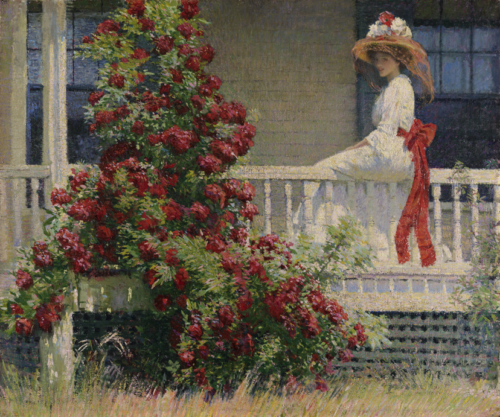
The Crimson Rambler, by Philip Leslie Hale, c. 1908. © Pennsylvania Academy of the Fine Arts.
In a way, this is a very good coming-of-age story. I’ll explain why. Here is a girl refusing to accept where she is from, refusing to accept the man who took her under his care, and often using him for her own gain. Turning to an outsider who wanted nothing but physical pleasure from her, who took and took and then left her with nothing. He chose someone from his own world, and in fact had always chosen her, leaving Charity in the dark. So she tries to find herself in the mountains and finds her mother, who had died just before Charity got there. As I was reading about the state of the Mountain, the uncanniness and the fear that Charity felt, I felt that Charity’s mother passing away was her final act of motherly guidance. Had her mother lived, Charity would have stayed in the Mountain. She would have left herself in harm’s way, in a dangerous environment, raising her child in a place her mother did not even want to raise a child in. But Charity couldn’t have known that, having grown up in the village. Charity’s mother is left nameless, nothing but a pawn in the story. She is never graced with a name, adding to the stark Otherness of the Mountain. You are never able to connect with this unnamed woman, which I believe adds to her role as guidance for Charity. Lawyer Royall comes back to take Charity home, and she is safe.
Lawyer Royall is possibly one of the most interesting characters I have ever read. He was a man who saved this baby from the Mountain. He wanted to do what was good for her, but did he succeed in the later years? Again, reading classics, one must be aware of outdated cultures. Lawyer decides, once Charity is of age, that he should probably marry her. On first reading this, I shivered in disgust. Did he desire this girl he raised from babe to teenager? Horrible! Charity immediately declines, and this pushes her more towards Lucius Harney, fearing a life of dullness. However, at the end of the book, once Lawyer finds out about Charity’s pregnancy, he pushes for the marriage. By this point, you feel an uncertain relief. Charity and her baby are safe from scavenging the streets, but at what cost? Must she give herself up to her adopted father? Will he force relations? Until the last page, on their wedding night, Charity lies on the bed, waiting in fear, but Lawyer simply sits on the armchair and leaves her alone. Charity realises she is safe. The book ends, and we are left with the impression that Charity is now cared for. You come to understand Lawyer Royall’s intentions. He knew the way to care for her in such a small village with no prospects was probably to marry her, once she grew past childhood. It’s a sad fact, but it is the reality of how unsafe it would be for an unmarried woman past a certain age, especially in an era of social stigma and vulnerability for women. And finally, the pregnancy is not something that could be overlooked. In that time period, she needed to be married to be safe. So Lawyer Royall did what he had to do. It’s interesting, isn’t it?
So why is this a coming-of-age, you ask? I think the story, of course, is out of the norm, not something the usual person goes through. But Charity searches for herself, finds it in an enemy, and in that process loses herself. She travels to great lengths trying to find her identity, and in the end comes to terms with who she is and who she is becoming. She may be of the Mountain, but she refuses to accept that. Revisiting the Mountain settled the inner hatred for her birthplace. She realised that her birthplace was not something to fear, but something to take forward with her. It does not rule over her life, but it did help her to accept where she was from rather than push it away. Then, she falls pregnant, and in that moment she grows up. She puts her child before her own interests.
Her pregnancy could be a metaphor for many things in life. Anything that makes an adolescent realise that there is much more out there than themselves. This is not to say that teenagers are selfish, but children are often unable to see past themselves or their immediate family. Their focus is usually on one thing entirely, whether it’s school or home life or something else. Whilst we as teens try to focus on more things, it is so hard to do so at that age. Most things they do are an extension of their current focus, and I think Charity is the perfect example of this. She wants to escape, everything she does is to escape. She gets a job to save money, she falls for an outsider, she runs away from home. Everything is for her escape. When she is exposed to the outside world and realises she now has more to look after than herself, she grows up.
So that is why I read this as a really good coming-of-age tale. It did leave me with a sick feeling in my stomach, knowing that Charity would likely now never fulfil her dreams. It is sad to see her story end that way, but Edith Wharton’s writing suits the realistic story of a wistful, dreaming girl better than a fantastical happy ending.
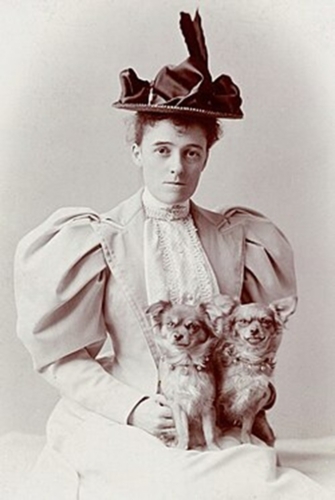
Edith Wharton, c. 1895. Wikimedia Commons.