


“She’ll never stop, and I will never be free.”
Synopsis
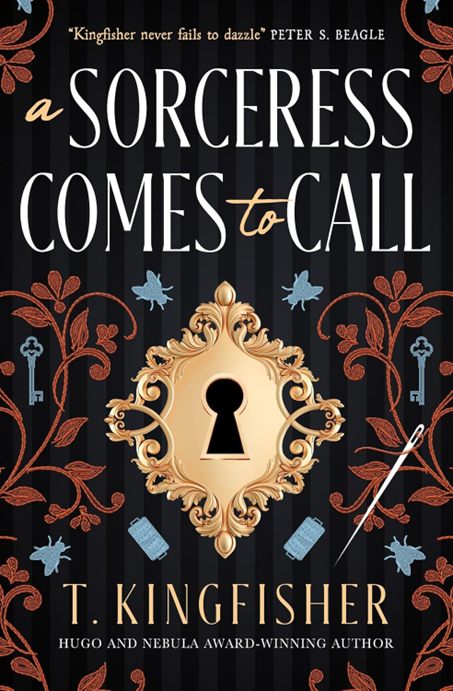
Fourteen-year-old Cordelia knows her home life is not normal. Or rather, her mother is not normal. There are no doors in her house, with no respite from the looming possibility that her mother could use dark magic to make her ‘obedient’. She is completely isolated, her only friend being her mother Evangeline’s familiar, Falada the horse. After a suspicious death in their hamlet, they leave in search of a rich gentleman for Evangeline to marry, their target being a naïve squire. Unfortunately for Evangeline, the squire’s sister, Hester, is determined to thwart her plans. This horror fantasy is told from both Cordelia’s and Hester’s perspectives.
If this chilling horror fantasy intrigues you, find it here:
Loose Retelling
A Sorceress Comes to Call is advertised as a retelling of the Brothers Grimm’s The Goose Girl, however, I would describe it as being inspired by the fairy-tale, as there are only loose connections between the two. In The Goose Girl, a princess is given a protective charm from her mother, along with a speaking horse, Falada, to watch over her. However, on the journey to the palace where she is to marry, the princess loses her charm in the stream, and her maid threatens to kill her unless they switch roles.
Once at the palace, the false princess orders Falada to be slaughtered to stop him from speaking the truth. The tale ends happily when the real princess is caught conversing with the magical, disembodied head of the horse, and the truth comes out.
In A Sorceress Comes to Call, the roles are completely inverted. Instead of a protective mother and a scheming maid, Cordelia’s maid is her ally, and her mother is a conniving woman who dangles her affections as a manipulation tactic. Falada is also more complex, at first seeming to be Cordelia’s only friend, before it is revealed that he has been betraying her secrets all along. He has a vicious personality, yet Cordelia is torn between hatred and pity because of the possibility that Falada is under Evangeline’s control too.
Blending Horror and Comedy
Kingfisher borrows these characters by name only, it seems, and twists what was already a dark tale into something far more gory and chaotic. Falada is still decapitated in A Sorceress Comes to Call, but instead of being mounted on a wall, his headless form stalks the other characters, revealing a true demonic nature trying to escape the equine form. He is a beast worthy of haunting the gothic moors.
“There were too many eyes and his legs had too many joints and his ribcage had cracked apart and the rib bones jutted up like teeth set in a jaw…”
Kingfisher is great at building tension; Cordelia’s skittishness and anxiety are palpable, and the descriptions of her being made ‘obedient’ are wildly uncomfortable. This involves her mother enchanting her so that she loses all bodily autonomy, effectively becoming a puppet. Not only is this an intrusive process, but one of the most sickening aspects is that Cordelia is only able to carry out automatic actions if her mother remembers to order her to do them.
“Her mother mostly remembered to have Cordelia relieve herself at regular intervals.”
“Her throat was dry and sore. Her mother had made her eat but had forgotten to have her drink anything.”
When feeling threatened by Hester’s friend Penelope Green, Evangeline makes Penelope ‘obedient’, forcing her to murder a maid before throwing herself off the balcony. It is a shocking and macabre scene, as Penelope is aware of what is happening but unable to fight Evangeline’s control of her body. She then haunts Cordelia, an invisible spirit speaking into her mind. However, in an interesting twist, Penelope’s ghost acts almost as comic relief, chatting informally and cracking jokes about her fate. This highlights an aspect I really enjoyed about Kingfisher’s writing: her ability to balance wry humour with such a dark plot.
Control
The book explores themes of parental abuse in a perceptive light; not only do we have Cordelia’s perspective, but also that of Hester, an outsider who understands the severity of what Cordelia is experiencing. Since this is all Cordelia has ever known, she has a warped view of the extent to which her mother is abusive, and Hester is pivotal in helping her free herself from her mother’s clutches.
Whilst there is a clear metaphor for real abusive dynamics in Evangeline’s ability to control Cordelia through making her ‘obedient’, A Sorceress Comes to Call does not rely on the fantasy elements alone to convey this theme. Evangeline is verbally coercive, and many of her traits would still be believable if she wasn’t a sorceress. Kingfisher captures the struggle surrounding loyalty and guilt that those raised by a narcissistic parent often experience.
Cordelia’s life is painfully entwined with her mother’s. Evangeline curates a sense of duty in her daughter, often playing the victim to force Cordelia to feel selfish for reacting with anything but devotion. She is insincere and manipulative, and yet, because she withholds her affection, it is all the more impactful when she does show ‘kindness’. As a result, Cordelia is stuck between hatred and the secret part of her that holds out hope her mother might truly love her. The following quote describing Cordelia embracing her mother, highlights this internal conflict:
“Cordelia stood quietly in her mother’s arms. Her skin crawled and she wanted to pull away, but she knew better. And part of her—a tiny part that she had never quite lost—wanted to be there and wanted it all to be true so that her mother would love her and maybe things would change.”
Female Characters
This is a very female-led book, which I really enjoyed. Yes, our villain is a woman, but so too are the main enactors of her downfall. Cordelia is shyly endearing, and her growing confidence when surrounded by positive female influence is heart-warming to see. Penelope is witty and unapologetically headstrong, even in her intangible spirit form, and Hester, our second protagonist, is an entirely refreshing character.
At 51 years old, Hester is a reluctant heroine with a terribly bad knee, but her persistent heart will not allow her to sit back and be a bystander to Cordelia’s abuse or her naïve brother’s swindling at the hands of Evangeline. Hester and Richard share a subtle but enjoyable romantic subplot, and I was glad it was between a mature couple rather than forced upon the teenage Cordelia, who still has to figure out her own identity. It is rare in fantasy to see middle-aged characters receive their happily-ever-afters instead of the younger protagonist, especially with the rise in popularity of formulaic YA romantasies.
Richard chuckled softly. “You haven’t changed.”
“I’m older and fatter and my knee hurts,” she said tartly, pulling her hands away. “And I have less patience for fools.”
“You look magnificent,” he said with absolute conviction.
Have you read this book?
We would love to hear your thoughts on this book, perhaps you agree with our review, or, disagree?
