


“We don’t have one mother, we have many.”
Synopsis
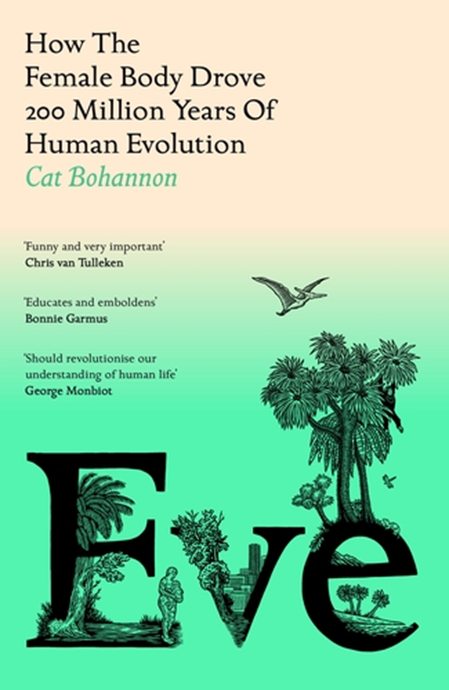
Cat Bohannon uses archaeological and fossilised evidence to create her thesis on human evolution, and how adaptations spearheaded by female bodies have shaped it.
I went into this book really sceptical about it — I mean, it’s a science book and I’m an arts person, so how much would I gain from it, or even understand it? Which probably makes you wonder why I picked it up in the first place… Well, it was a customer who recommended it to me, claiming that “it was a book every woman should read,” and that intrigued me.
Even still, I procrastinated starting it, as it was over 600 pages (turning out to be around 400 pages of content, with over 200 being notes and sources!!). However, once I cracked it open on my way to the dentist, I was greeted with a passage about one of my favourite film series, Alien. Specifically, Bohannon references one of the newer additions, Prometheus (confusingly a prequel) and its central horror themes of pregnancy and the parasitic invasion of a host. Indeed, the first victim of this is a man (the Alien, chestburster scene), and thus starts a discussion of how the female body and its processes have been ignored and shadowed, despite literally being the beginning of life. And I was hooked.
If this reframing of human evolution through the female body intrigues you, find it here:
Accessible Science and Feminist Storytelling
Throughout the book, Bohannon retains a tone of feminist discussion, even when talking about human developments such as nipples, the womb, limbs, our brains, ears, the use of tools, and many other evolutionary benefits that our different Eves (the stages of human development discovered through fossils and bone fragments that Bohannon categorises into different “characters” for the reader to understand) gave us. We have:
- “Morgie” (Morganucodon), 205 million years ago: Eve of mammalian milk.
- “Donna” (Protungulatum donnae), 67-63 million years ago: Eve of placental mammals.
- “Purgi” (Purgatorius), 66-63 million years ago: Eve of primate perception.
- “Ardi” (Ardipithecus ramidus), 4.4 million years ago: First known bipedal hominin.
- “Lucy” (Australopithecus afarensis), 3.85-2.95 million years ago: Tool use, lived in both trees and on the ground, fully bipedal.
- “Africanus” (Australopithecus africanus), 3.3-2.1 million years ago: Descendant of Lucy, larger braincase and smaller teeth.
- “Habilis” (Homo habilis), 2.8-1.5 million years ago: Eve of simple tools and associated intelligent sociality.
- “Heidelbergensis” (Homo heidelbergensis), 790,000-200,000 years ago: Probable ancestor of Neanderthals, Denisovans, and Homo sapiens. First species to build shelters of wood and stone, use fire and hunt with wooden spears.
- “Neanderthals” (Homo neanderthalensis), 400,000-40,000 years ago: Burials, clothing, fire, tool and jewellery making, and possible language.
- “Erectus” (Homo erectus), 1.89-110,000 years ago: Complex tool user, larger brain, highly migratory.
- “Sapiens” (Homo sapiens), roughly 300,000 years ago: Eve of human language, menopause, modern love, and sexism.
- “Denisovans”, not formally described, 500,000-15,000 years ago: Lived in Siberia and eastern Asia, potentially passing down genes facilitating survival at high altitudes.
These are all broken down into segments that are accessible and understandable to someone with a very basic understanding of science. Bohannon has longer paragraphs describing each in fuller detail, but I have tried to condense them as much as possible, while still providing the most important information.
I was pleasantly surprised by how quickly I could read this book, despite having to put it on temporary hold over the Christmas period while working as a bookseller. Once I got back into it, I was hooked again. The beauty of this work is that it doesn’t need to be read quickly; it can be read in slow drips of information, allowing the reader to dip in and out when it benefits them. This is aided by the tone Bohannon maintains throughout the narrative. Even her footnotes, which provide additional context, continue the same feminist and informative tone when further dissecting elements of our history.
I hope this example highlights what I mean: “both mother and offspring are vulnerable… [in the footnote:] This is also true among the poor and oppressed today: more than 50 percent of Indian women […] are currently suffering from malnutrition […] in no small part to the tradition where young women eat last. […] If we are to invest in humanity’s future, we have to feed human mothers and we have to feed them well. It would also be nice if we’d stop abusing and killing women in general, but let’s start with the food.” This tone demonstrates Bohannon’s ability to use a blend of scientific evidence to support her claims, while also showing that sociological beliefs can be conveyed at the same time.
Blending the Science with the Sociological
Bohannon doesn’t just focus on the scientific, but also weaves social discussion throughout. She doesn’t shy away from topics that may be harmful or triggering, so please bear this in mind if you do choose to read it. She discusses issues such as the inequalities men and women face across different societies, and how, despite women being the providers of life (i.e. being the ones to literally create eyeballs inside their own bodies!), they are still confronted with ideas of “male superiority” and labelled the “inferior sex.” What Bohannon demonstrates here is just how ridiculous these ideas are, using not only sociological arguments, but scientific ones, too.
For example, when discussing women in combat spaces, Bohannon writes: “Maybe the debate about women in combat isn’t about what men’s and women’s bodies can or can’t do […] maybe it comes down to the idea of women’s bodies in the world—what they’re supposed to do, what they aren’t, and how they serve as a counterpoint to the idea of Manhood.”
As somebody who studied Sociology, these ideas are particularly interesting to me, as they are often dismissed outside of those discussions. Scientific evidence is frequently used to argue against them, and yet Bohannon shows that, in some cases, science can actually support these claims. For example, the chapter this quote is taken from highlights how women are structurally built for endurance, while men are built for quick bursts. Bohannon argues in this chapter that a combination of both would be beneficial to establishments such as the military, yet women are often dismissed on the grounds that they are not “built for war.” As shown in this quote, Bohannon highlights why she believes this is the case, and that it is not down to biology.
Taking Back Her (Not His) Story
Women’s history (and even still their present) has long been overshadowed by patriarchal systems and institutional prejudice. For too long, the story of evolution has been told through male perspectives, but here, Bohannon reclaims our shared story and challenges ideas that have plagued evolutionary debates since the beginning. With conviction, she demonstrates that women’s impact on both the world we live in and the bodies we live in is irrefutable. The synopsis on the back cover captures this perspective clearly: “Women created life, then we erased their story. It’s time for science to tell it.” By blending the scientific with the sociological, Bohannon rewrites our history, entering spaces that have largely been ignored by misogynistic historians and scientists, and ultimately revealing the herstory of evolution.
It really is a book that all women should read, as it is our journey, our bodies that have driven these changes, and our suffering and courage that have shaped the lives we live today. It highlights how Eve’s influence has led to this moment — allowing me to read, understand, and analyse the book, and now pass that understanding on to you.
Overall
This is really an inspiring book, granting us the information needed to understand how our bodies have shaped evolution. All of the Eves who have driven our ever-shifting experience on this planet have long been forgotten, but through Bohannon’s book, they are granted another life, where their sacrifices and adaptations that our bodies have benefited from are recognised. With this in mind, I couldn’t really give this book anything other than five stars. It is inspirational, influential, eye-opening, and genuinely interesting, offering a chance to learn about science from a female-centric perspective, and how that past has given us our present and future.
Have you read this book?
We would love to hear your thoughts on this book, perhaps you agree with our review, or, disagree?
