


“Grandma once told me that the challenges faced by Vietnamese people throughout history are tall as the tallest mountain.”
Synopsis
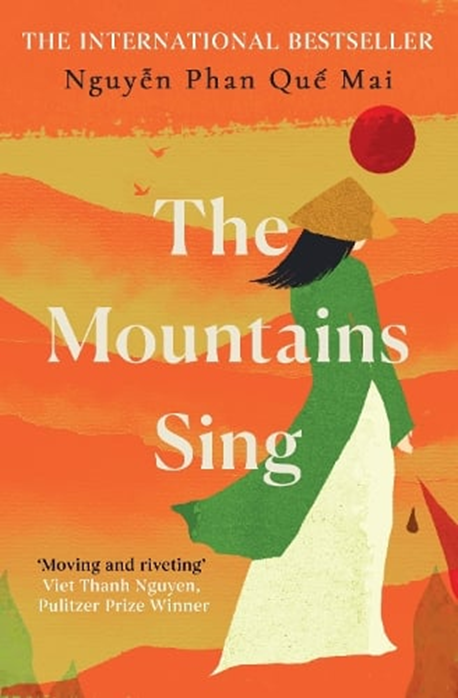
The Mountains Sing is a lyrical coming-of-age story set in 1970s Vietnam, weaving a multigenerational story of the grim realities of war, love, loss, and identity. It begins in Ha Noi, 1972, where Huong clings to her grandmother during an American attack, and from there unspools the stories of two generations of women and war.
It is highly apt, then, that it was my grandmother who not only recommended this book, but gave it to me. Throughout the story, the overarching connection between Huong and her grandmother is incredibly bittersweet, overcoming war and family complications. Ultimately, throughout it all, the unwavering love for each other endures.
If this multigenerational story of war, memory, and enduring love speaks to you, find it here:
Multigenerational Storytelling
Huong’s life will never be the same, but to her grandmother, this situation is eerily similar to her own childhood, when her family faced attacks and exclusion. Through Mai’s beautiful prose, she discusses difficult topics such as class struggles, famine, and the effects of war on a community in such a beautifully tragic way that her lyricism sings.
For example, she discusses the death of her grandmother and the impact she has made on her life. “I have stood far enough away to see the mountaintop, yet close enough to witness how Grandma became the tallest mountain herself; always there, always strong, always protecting us.”
Through the lens of two families and two storylines, the reader is swept into an epic and tragic tale about the Tran family, and how war has pushed and pushed them down, yet love remains constant throughout. Despite all the tragedies, their love is their strength. This is emphasised when Mai herself burns the manuscript of her book to share with her ancestors, particularly her grandmother. The quote reads: “In the twirling ash, I see the Sơn ca moving… calling my grandmother’s songs towards Heaven.” This is Mai highlighting that the story is not just her own, but also that of those who came before her, too.
Love, Loss, and Endurance in a Time of War
Following the timeline of war allows Mai to dissect grief and loss, and how, over time, people change, especially when facing traumatic events. Huong’s grandmother faces a great deal of challenges throughout her life, having to make difficult decisions that she knows she will be hated for, but must go through in order to keep her family safe. An example of love, grief, and loss appears in this quote, which highlights that just because someone may not have died does not mean that they are not lost: “I realized that war was monstrous. If it didn’t kill those it touched, it took away a piece of their souls, so they could never be whole again.” Mai’s meaning here, of course, is that trauma removes parts of people, removing their soul, even if they’re not dead.
Another quote that highlights this closeness to family is this one: “If I had a wish, I would want nothing fancy, just a normal day when all of us could be together as a family; a day where we could just cook, eat, talk, and laugh. I wondered how many people around the world were having such a normal day and didn’t know how special and sacred it was.” This quote feels highly apt, especially during such a turbulent time in history. This kind of normal day is taken for granted by so many of us around the world, while families in other countries would long for a day like this, where they are not living in constant fear of their lives.
This leads to an exploration of family complexities as their extended family shrinks over the duration of the story, through death and exclusion, especially when Huong’s grandmother becomes a trader, a profession despised in Vietnam as it represented everything they stood against: capitalism and exploitation. Despite her family looking down on her, Huong’s grandmother had to take up trading in order to earn money and survive. This is just one step in a long ladder of difficult decisions she was forced to make to protect her family.
Conclusion
Overall, The Mountains Sing is a coming-of-age love story centered on family and community, and the hardships they face together. Without the people who make sacrifices for each other, fuelled by love, there would be no reason to do hard things for one another. Throughout the story, Mai highlights the true importance of family, and how, even in moments of difficulty and stress, the love of a mother can be life-saving.
With this, it feels right to give this book four stars. Despite my “enjoyment” (which does not feel like the right word to use, considering the book’s content), there still felt to be something missing, hence why I can only give it four stars. Still, a very good book, indeed, and I can understand why my grandmother recommended it to me!
Have you read this book?
We would love to hear your thoughts on this book, perhaps you agree with our review, or, disagree?
