

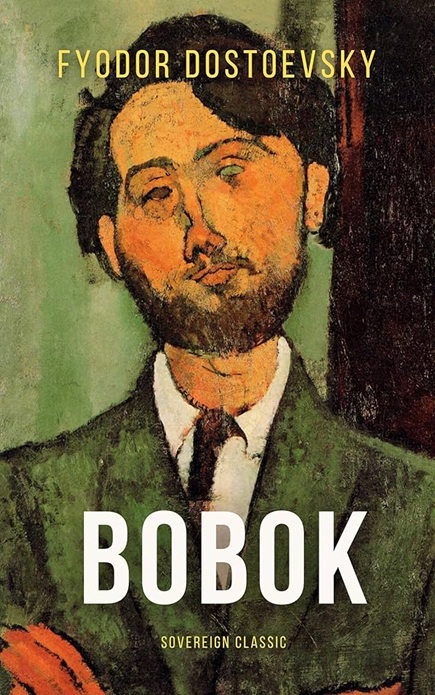


When finishing my thorough analysis of White Nights, I was pleasantly surprised to uncover another short story, Bobok, tucked into the final pages of my Penguin edition. Curious, I browsed online and noticed there wasn’t much in-depth analysis on Bobok, beyond surface-level opinions of the cemetery voices. However, in true Dostoyevskian fashion, there is always more beneath the surface, which I felt compelled to explore.
Synopsis
The story begins with “THE NOTES OF A CERTAIN PERSON”, where we are introduced to a struggling writer, Ivan Ivanych, who describes himself as shy, often made out “to be a madman.” He laments his repeated literary publication failures, which eventually relegate him to working as a French translator for booksellers. It becomes increasingly apparent that he feels alienated from society — misunderstood in his wit, thought process, and literary voice.
His tone is self-defensive, perhaps understandably so, yet he already constitutes an unreliable narrator early on, as even his peers begin to notice erratic changes. In search of a distraction, he attends the funeral of a distant relative, where he overhears voices from the graves of both the social elite and common folk. The disparity in morality, misdeeds, and secrets he uncovers not only astonishes him but intrigues him further, sparking renewed inspiration for literary work he hopes will finally be accepted. In the end, we are left with a man in conflict, torn between his ideals and the dark truths that lie beneath…
The ramblings of a madman…
“I read: Go take a look at his sickly face that is on the verge of madness”
Throughout the narrative, Ivan not only displays mental and psychological unravelment, but physical manifestations of madness as well. From the onset, the artist who paints his portrait mirrors an outward reflection of his psyche, which Ivan sharply notices:
“Even if my face is like that, really how can one be so direct in print? In print everything should be noble: there should be ideals, but here…”
Ivan seems aware of his imperfections and struggles to accept his physical flaws, highlighting his insecurity and dejection, further compounding the alienation he already feels from society. This is reiterated further when he notices the painter’s fascination with his “two symmetrical warts” on his forehead, which he regards as “a phenomenon.” The artist even utilises the technique of realism, making them even more “lifelike.” This exaggeration, or unflattering realism, is quite significant, as Dostoevsky employs the vices of physiognomy (which dates back to Aristotelian philosophy, where facial features were viewed as emblems of one’s divinity or personal character). In this example, the warts (the physical) transcend into the metaphysical — an embodiment of Ivan’s mental instability, stress, and imperfections.
In retaliation, or perhaps self-defence, this leads Ivan into a rambling tirade against authority and institutional influence, revealing his resentment and anger toward perceived personal judgement. He explicitly criticises authorities for their self-imposed moral and rational superiority, and their confidence in diagnosing madness within society. This is exemplified in the passage:
“They locked up all their fools in a special building to reassure themselves that they’re the sane ones. But really, locking somebody else up in a madhouse doesn’t prove that you have brains.”
This highlights how simply thinking differently, or displaying characteristics that deviate from the norm, can already box an individual into the notion of madness — something Ivan feels he himself has been “locked up” in. This reflects the harsh reality of failing to conform to societal ideals and expectations. It’s a very clever moment of introspection, as Dostoevsky, through Ivan, invites us to consider an alternative lens of reality: what if these laws or social guidelines aren’t inclusive at all, and are the true reflection of madness?
This perspective is reinforced when Ivan states:
“In my opinion, the one who’s smarter than all the rest is the one who calls himself a fool at least once a month…”
The ability to recognise one’s flaws and exhibit the full range of human emotion is presented as a form of authenticity and normality. By contrast, suppressing emotion in order to maintain a constant, seemingly “sane” psyche is portrayed as artificial and inhuman, as it fails to capture the innate human experience — something Ivan is explicitly trying to expose.
But as established, Ivan is an increasingly unstable figure, as he senses his own nature shifting and begins “to see and hear certain things.” Most significantly, he develops a fixation on hearing the repeated utterance of “Bobok, bobok, bobok!” — the title refrain of the story itself, echoed throughout the narrative. Whether this signifies auditory hallucinations due to mental instability, or a calling from the dead (almost haunting), remains deliberately ambiguous. Perhaps Dostoevsky hints at an answer here: for what would compel Ivan to lay himself down upon a stone shaped like a coffin?
Immorality without Consequence?
“He observed that the stench that is smelled, so to speak, is a moral stench! He-he! The stench coming from our soul, as it were…”
In the second half of the story, we’re engulfed by a flurry of voices and characters, used to portray a realm deprived of morals, driven by personal gratification in life and beyond. The social elites, in particular, show little remorse for their past wrongdoings, appearing largely indifferent to their circumstances. This disparity is evident when compared to common people, such as the Shopkeeper, who finds himself in petty disputes with his aristocratic neighbour, Avdotya Ignatyevna (a woman who cannot even tolerate being buried beside him). Despite owing him money, she retains a sense of moral superiority, accusing him of dishonesty while openly mocking what she owes.
The Shopkeeper, by contrast, is contemplative, recognising that none of it truly matters anymore, as they have reached “the judgement seat of God we are equal in our trespasses.” Unlike Avdotya, he understands the weight of his circumstance and reflects upon his own moral failings, accepting that he too may have wronged others. Dostoevsky uses him as an instrument of moral consequence; through religion, he acknowledges that actions on earth are not without judgement.
This is shown through the Shopkeeper’s anxious fixation on the passing of forty days, a period religiously associated with preparation and judgement. He cries out to Avdotya, asking whether he is already “in torments now,” as though hell has begun amid such open immorality. Avdotya remains unmoved. She mimics the word “trespasses” with disdain and demands that he stop speaking to her, suggesting an acceptance of her nature and the refusal to reflect.
Her moral hypocrisy intensifies when she accuses him of smelling bad, a claim he sharply rejects:
“There’s no particular smell coming from me, because I’ve still managed to preserve my body whole, while you, my lady, have really started to go bad… the smell indeed is unbearable, even for this place.”
This moment is significant, as it introduces the idea of moral stench, which Platon Nikolaevich, the Philosopher in the cemetery, defines as spiritual rather than physical “smell.” Consciousness, he suggests, continues by inertia (the physical remains unchanged unless acted on by an external force), implying that moral corruption can persist beyond death. Without the metaphysical force for change, some of these individuals were never going to change. The Shopkeeper’s claim of having a “preserved” body refers not to physical integrity, but to conscience and penance, in contrast to Avdotya’s moral decay.
The true source of this moral stench is revealed to be Baron Klinovich, who embraces immorality openly:
“You were wrong to suspect your merchant neighbour of smelling bad… I just kept quiet and laughed. You see, it’s me.”
Klinovich functions as a catalyst for moral collapse, encouraging gratification and immorality without conscience, leading to the hedonistic frenzy that consumes the cemetery by the story’s end.
What does it all mean?
Alongside moral decay, Bobok unravels the deeply disturbing nature of lust and depravity, particularly towards adolescents. This is embodied through major aristocratic figures, such as Councillor Tarasevich, Avdotya Ignatyevna, and most significantly, Baron Klinovich — the primary catalyst of this depravity. Klinovich himself was once a victim, having been “corrupted” at fourteen by Avdotya, yet continues to perpetuate the same dark cycle.
Tarasevich is described as almost breathless with excitement, admitting that current circumstances (the presence of young girls) feel like a dream come true. In moments like this, the Shopkeeper’s earlier fear begins to feel disturbingly justified: perhaps this is hell. In Bobok, death does not purify; it liberates depravity.
What would human nature look like with no social or legal constructs, no religion, no moral compass — if humans were free to act without consequence? Would we simply succumb to our individual, innate desires? Perhaps Bobok offers a glimpse.
Have you read this book?
We would love to hear your thoughts on this book, perhaps you agree with our review, or, disagree?
