
Buddy Read
Includes Spoilers
Reviewed by Olivia and Nina
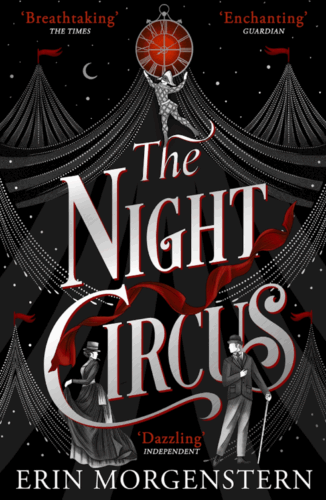
Olivia's Rating: ⭐⭐
Nina's Rating: ⭐⭐⭐
Olivia's Thoughts:
I was thoroughly underwhelmed by this book. After reading so many lovely reviews of The Night Circus, I thought I was bound to love it. As someone who loves a darker, moody atmosphere (something akin to a Tim Burton style), it sounded right up my street!
And stylistically, the atmosphere is perfect. It was the pacing (or lack thereof) that I struggled with. Nothing really happens until around the 330-page mark (out of 498), which felt too late in a book I've immersed a lot of time in and have considered putting down several times. It leans heavily towards style over substance. And while Morgenstern's words are beautiful, the book struggled to grip me because of the lack of action.
As well as this, I found the characters lacking depth, with the exception of Celia and Tsukiko. I wasn't captivated by any of the main cast — especially Marco, who was bland as plain paper. Their romance wasn't convincing either. It contradicted one of the cardinal rules of writing (which isn't always necessarily true, but in this case I felt it definitely was!): showing rather than telling. Morgenstern adamantly tells us that Celia and Marco are in love, but I couldn't see it anywhere. I saw more affection between Hinata and Tsukiko in the brief passage where their romance is mentioned than in the long sequences of Celia and Marco.
THIRTY YEARS of supposed yearning, and I saw nothing. No chemistry whatsoever between the two, and yet we're supposed to believe they've been in love the whole time, even though they're batted against each other (but who doesn't love a good ol' enemies-to-lovers trope). Except, I saw nothing of the sort! There were no enemies, there were no lovers — just two awkward people being weird in each other's presence.
It was something I was severely underwhelmed and disappointed by. After well over a week of trying to read this book, it ultimately let me down. I kept persevering because Nina was further ahead than me and was enjoying it, and I thought that if I just carried on, I'd get there too. But I didn't feel like it paid off. In the end, I think we both left this book disappointed and frustrated that the investment hadn't paid off.
Nina's Thoughts:
I really wanted to love this book, and in many ways I did — but unfortunately, not enough. The premise enticed me with dark whimsy, a challenge entwined with magic, and a romance cursed by rivalry, not to mention the Victorian setting, which is one of my favourite historical eras for magical realism.
It was the pacing that initially made me stall. I don't mind non-chronological chapters, but the way The Night Circus jumped around in time, location, and character right from the get-go left me feeling slightly disoriented, as I didn't yet have enough familiarity with the characters to ground my focus. That said, I can see how this structure contributed to the air of mystery required for the build-up — it just needed a little more balance for me to feel properly immersed.
Additionally, I struggled with the use of present tense throughout. I often found it hard to remember the order in which events were happening, especially when reading about something set years ago in the present tense. I frequently found myself having to flick back to previous chapters to check dates and reorient myself.
That being said, once I got to know the characters better, I did really enjoy them — especially Celia, Tsukiko, Poppet, and Widget. I found Celia to be an interesting and likeable main character; she was clever, focused, and emotionally mature. I think I would have enjoyed the novel more as a narrative, following her journey of breaking free from the restraints imposed by her father and finding independence, rather than spreading the narrative across so many individuals.
Because of my attachment to Celia, the ending didn't quite satisfy me. Yes, she built her own ending, but she did so within the confines of the very thing her father tied her fate to — and that felt flat. It didn't feel like a victory, but it wasn't inevitable enough to be a tragedy that truly pulled at the heartstrings either. I found myself wanting more for Celia and ultimately feeling disappointed.
Furthermore, it irritated me that there was no real comeuppance for Hector, Celia's father, despite his abuse of her during childhood. While he is left in a liminal state as a result of his own over-ambition with magic, this didn't feel like sufficient retribution. I wasn't expecting an unrealistic happy ending, but it felt as though Celia's drive to distance herself from his control was forgotten towards the end.
In terms of the circus itself, I absolutely loved Morgenstern's descriptions. The tents were immersive and whimsical, creating an alluring atmosphere. The Rêveurs community felt like the true soul of the circus, and Morgenstern's ability to create such a mystical array made me feel like a Rêveur myself. I really enjoyed the clockmaker, Herr Thiessen, and the intricacies of his craft, along with his passion for the circus. I would have enjoyed knowing more about his inventive process, although I suppose that is the mischance of it all.
I particularly liked the fact that Celia and Marco repurposed the challenge meant to pit them against each other into a collaboration that created something beautiful. This had all the potential to be a compelling love story: one centred on falling in love with the crafts of one another's mind — but their chemistry wasn't strong enough to pull it off. I don't need romance to be loud, obvious, or explicit; I appreciate subtle love stories, but their relationship didn't fit into either of these categories for me. It felt as though there was no real foundation to their feelings.
I found myself longing for a gradual build-up that showed why they fell in love, but instead I was met with a very 'insta-love' dynamic that jumped straight to dramatic declarations. Even though their story spans thirty years, I felt we were missing insight into where these intense affections stemmed from.
From Celia's perspective, I can understand how she falls in love with Marco through his tents at the circus, but ultimately, they don't know each other. I felt this romance needed to be developed in two stages: first, falling for each other's creations, and then a second build-up focused on falling for the person behind them. This was further undermined by Marco's vague personality and by Isobel, whose role was confusing — are we to believe she was in a 'situationship' with Marco for thirty years while he pined over Celia?
The Night Circus left me with mixed feelings when it came to rating it. Much of Morgenstern's prose appealed to me, particularly her attention to detail and the way she wrote sensory experiences — but, ultimately, the actual plot did not hook me. Yes, there were moments that made me gasp out loud; for example, the revelation that Tsukiko was a previous survivor of a challenge was a twist I really liked. However, this only heightened my sense that I'd missed out on learning more about Tsukiko and Hinata's backstory. I spent the rest of the novel hoping for more insight that never came, despite how rich and interesting Tsukiko's past would have been to explore.
Furthermore, tying Bailey into the circus at the end felt unsatisfying. It seemed as though we'd learned very little over the past 300+ pages about the dangers of binding magic. Even though Bailey had a choice, that alone doesn't absolve the circus of the way it feeds on and ultimately destroys its keeper. I would have liked to see more progression here.
All in all, there were many sections I enjoyed, hence my rating of a solid three stars. Perhaps this is the type of novel I would gain more from on a reread, as I'd likely notice smaller yet significant details. My conflicting stance on The Night Circus may suggest that while its plot didn't work for me, there is great merit in Morgenstern's writing style, and therefore her other novel, The Starless Sea, remains on my TBR.